

The Academy Trust Handbook 2026 took effect on 1 October 2026, replacing the 2025 edition. It was published in July, so most trusts will have seen it, but 1 October is the date its requirements started to apply. For the first time, the handbook contains a requirement that is specifically about energy. If you run finance or operations for a multi-academy trust, it changes how your next gas and electricity renewal needs to be evidenced.
This article sets out what the handbook actually says, what changed between the July publication and the final wording, and what we think trusts should do about it. It is not legal or procurement advice. Your accounting officer and auditors remain responsible for your trust’s compliance decisions.
What the handbook says
The new requirement is paragraph 2.29, in the “Procurement and spending decisions” section:
“Trusts must use DfE’s Energy for Schools service or a DfE approved Energy deal as shown under Energy on Get Help Buying for Schools unless an alternative agreement of equivalent value for money has been sourced. This will apply when your energy contracts are renewed.”
Two neighbouring paragraphs matter just as much. Paragraph 2.27 says trusts must consider DfE opportunities when making purchasing decisions and record their decision-making. Paragraph 2.25 restates the general duty: a competitive procurement procedure must be in place, the rules and thresholds in the Procurement Act 2023 must be followed, and the Find a Tender service must be used where required.
So the energy rule does not sit on its own. It adds a specific test on top of duties that already applied.
The wording changed in September
When the handbook was first published on 15 July 2026, the energy exception referred to an alternative agreement with “comparable pricing”. On 17 September 2026 the DfE updated paragraph 2.29, and the published handbook now reads “equivalent value for money”.
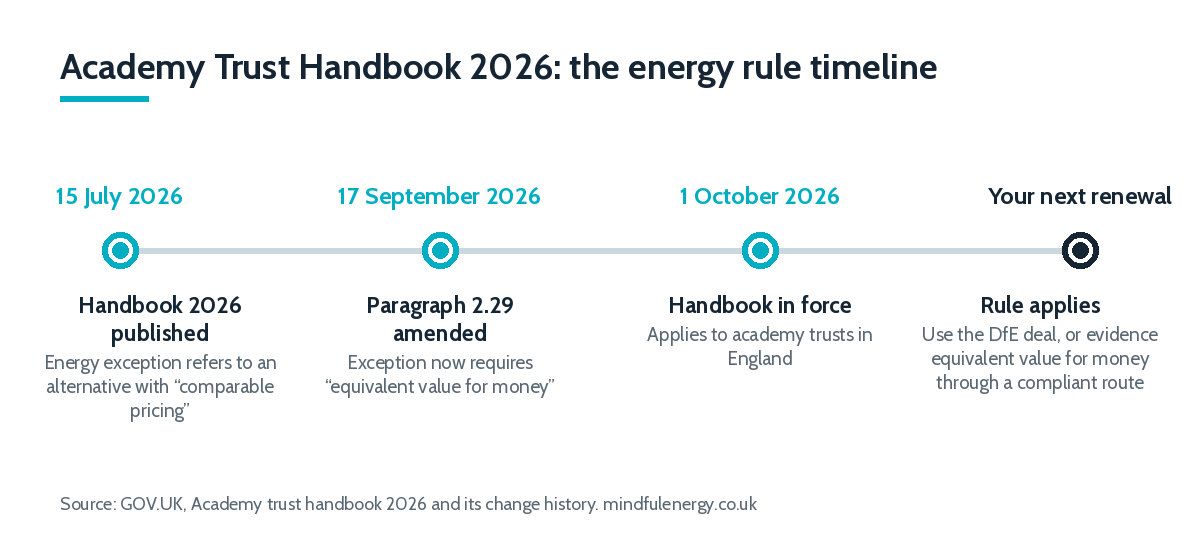
That is a meaningful shift. “Comparable pricing” invited a comparison of unit rates alone. “Equivalent value for money” asks about the whole arrangement: price, yes, but also contract structure, budget certainty, risk, and the services that come with the supply. Some commentary written over the summer still uses the earlier wording. The handbook is the governing document, so it is the September text your trust should work to.
What is the DfE Energy for Schools service?
Energy for Schools is the DfE’s own supply arrangement, delivered through the Government Commercial Agency (formerly Crown Commercial Service) under what is known as the V30 contract. The DfE describes it as buying energy “over a long period of time, reducing the risk to customers of substantial fluctuations in price”. In practice that means a variable, risk-managed price rather than a fixed one, with customers admitted in baskets. The current intake closes on 6 November 2026 for a basket starting on 1 April 2027, and the DfE notes that schools “may be placed on an interim rate to start with, depending on your current contract’s end date”. Our understanding is that the arrangement also carries a long notice period, so trusts should check the exit terms carefully before joining.
None of that makes it a bad option. For many trusts it will be a sensible one. But it is a different product from a fixed-price contract, and the two carry different budget risks. That difference is exactly what a value-for-money comparison should capture.
Two separate tests
This is the part we most want trusts to take away, because it is easy to get wrong.
Test one: value for money (paragraphs 2.27 and 2.29). If you want to use an alternative to the DfE deal, you need evidence that it offers equivalent value for money, and you need to record the decision. A properly run competitive tender, with every offer set out side by side against the DfE baseline, is good evidence for this test.
Test two: a compliant procurement route (paragraph 2.25). Separately, the contract has to be let through a route that complies with the Procurement Act 2023. From 1 January 2026 the threshold for sub-central goods and services contracts is £207,720 including VAT, and the aggregated value of a trust-wide energy contract over its term will often exceed it. Above threshold, a compliant route generally means calling off from a compliant framework or dynamic market, or the trust running its own regulated procurement with notices on Find a Tender.
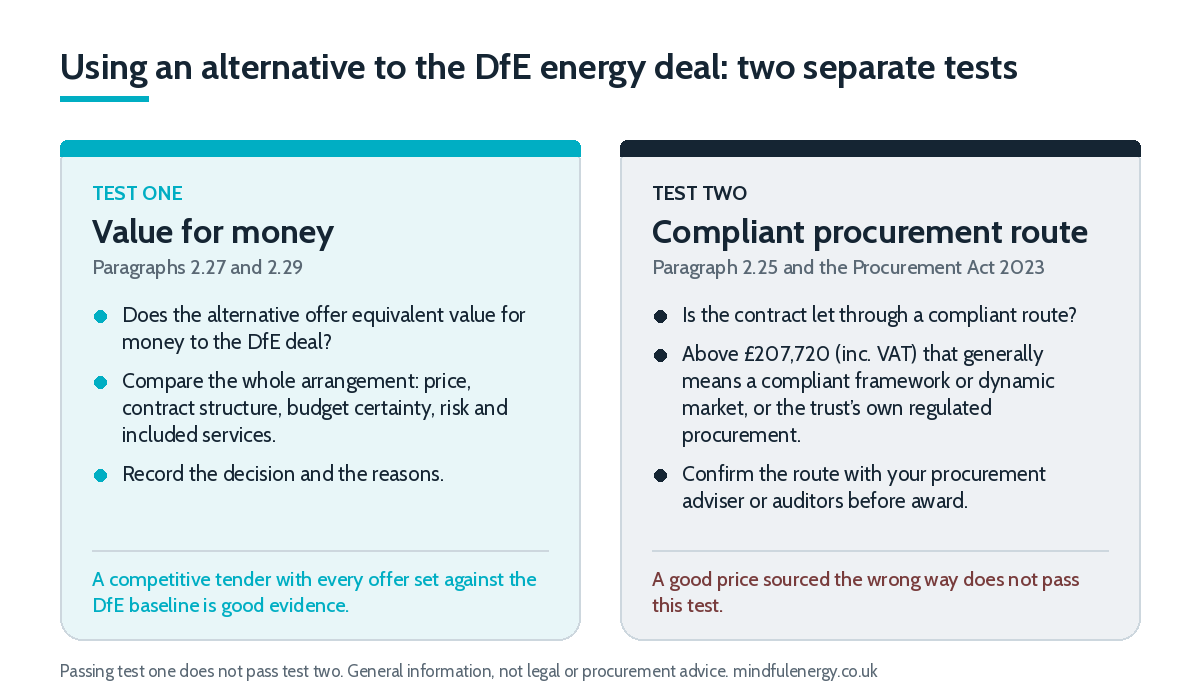
Passing the first test does not pass the second. A good price sourced the wrong way is still a problem for your regularity statement.
Where an independent broker fits
We should be straight about our own position. Mindful Energy is an independent third-party intermediary. We are not a public procurement framework or dynamic market, and nothing we produce certifies a trust’s compliance.
What we can do is run the competitive process and build the evidence. For trusts we work with, that means pricing the whole trust as one portfolio across multiple licensed suppliers, presenting every offer with all-in rates, separating unit rates, standing charges, Climate Change Levy and VAT, disclosing our commission in full, and benchmarking the result against the DfE Energy for Schools baseline. That is the material your board and auditors need for test one.
For test two, we recommend that every trust confirms its intended procurement route with its procurement adviser or auditors before award. Where a trust prefers to call off through a DfE approved framework, we can still help with the analysis. Where a trust runs its own compliant procurement, we can support the market engagement and evaluation while the trust owns the process.
What we suggest trusts do now
Check when each of your energy contracts ends and what notice they require. Many trusts hold a patchwork of individual school contracts with different end dates, and aggregating them is often where the value is.
Decide early whether you will use the DfE deal or seek an alternative. If you are leaning towards the DfE service and your contracts end around spring 2027, note the 6 November 2026 application deadline.
If you seek an alternative, plan for both tests from the start: a documented comparison against the DfE baseline, and a confirmed, compliant route to contract.
Record the decision. Paragraph 2.27 requires it, and a short paper that sets out the options considered, the comparison made and the reasons for the choice is far easier to write at the time than to reconstruct for an auditor later.
A note for independent schools
The Academy Trust Handbook applies to academy trusts in England. Independent schools are not bound by paragraph 2.29. Even so, the discipline it describes is a reasonable standard for any school: compare properly, understand the risk you are taking on, and write the decision down.
Talk to us
You can read more about how we work with trusts on our energy for multi-academy trusts page. If you would like to talk any of this through, or you want a second opinion on a renewal, book an informal call. There is no charge and no obligation.
Sources: Academy trust handbook 2026 (GOV.UK) and its change history; Energy for Schools on Get Help Buying for Schools; PPN 023: 2026 threshold amounts. This article reflects our understanding at the date of publication. It is general information, not legal or procurement advice.